Behind Karur’s Tragedy
Sch. Nibin Daniel
III B.Ph., JD, Pune.
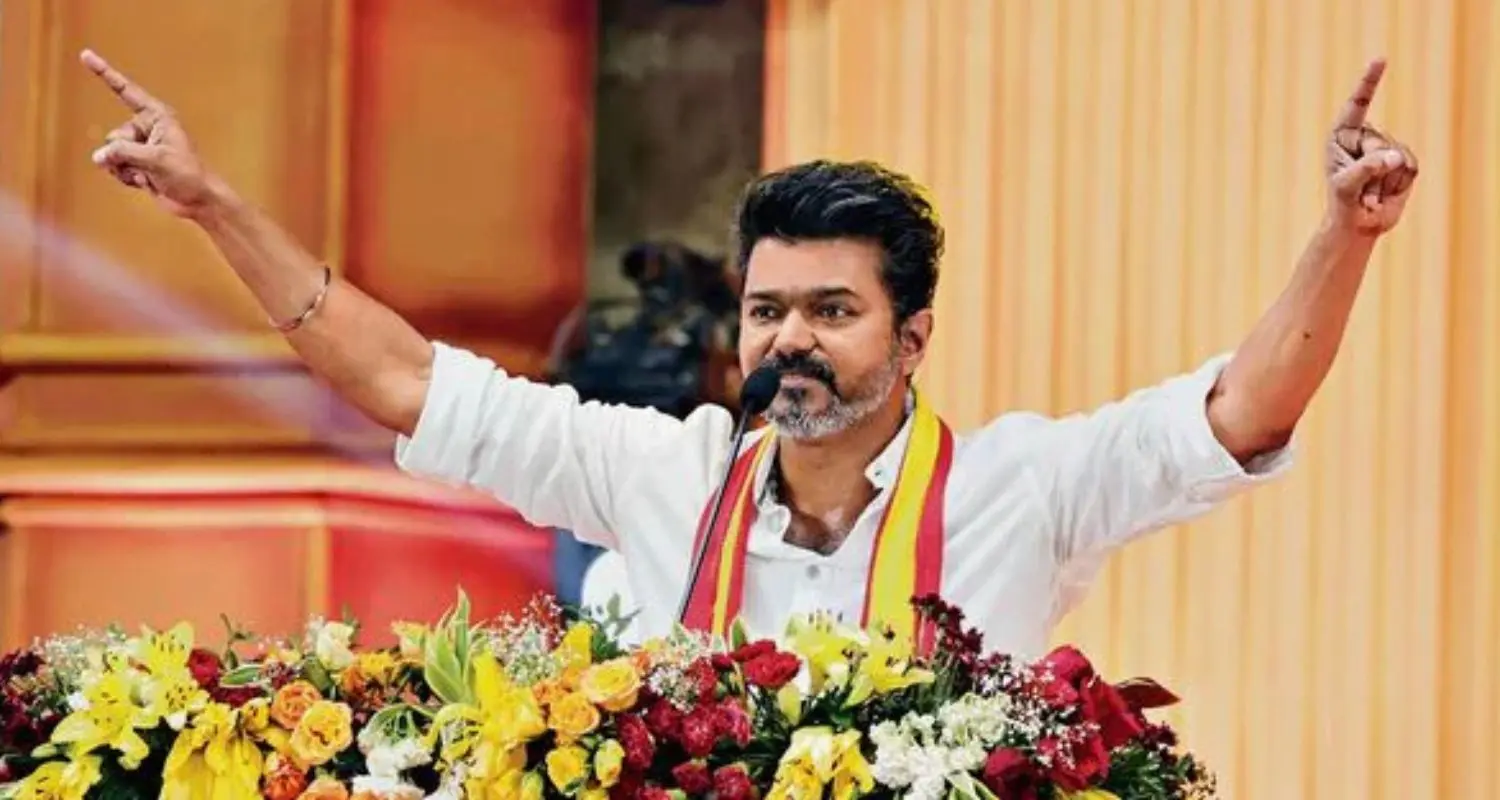
A song from Vijay’s film Sarkar, titled Oru viral Puratchi ‘One-vote revolution’, helped establish his image as a revolutionary figure. The question remains whether a song or film can truly predict someone’s potential as a political leader. Cinema in Tamil Nadu reaches every corner of cities, towns, and villages, exerting a significant influence. Historically, some people have begun to see actors and actresses as gods or political leaders. Numerous stories highlight Tamil Nadu’s politicians with backgrounds in cinema.
In this same motion, on September 27, 2025, a political rally in the Karur district of Tamil Nadu became sensational news and a scene of unspeakable horror. Forty-one people, including a two-year-old child and eight other children, lost their precious lives in a stampede during the campaign of Tamilaga Vettri Kazhagam (TVK) featuring actor-turned-politician Thalapathy Vijay. The tragedy unfolded when crowds surged towards Vijay, whose arrival was delayed by nearly seven hours. More than a thousand had gathered since morning, enduring scorching heat without adequate food, drinking water, or facilities. When Vijay finally arrived after dark, three separate crushes occurred—first as his fans tried to see him, then to hear him after his microphone failed, and finally as people chased his departing bus. Over 100 people were injured, ranging from fractures to suffocation, marking one of Tamil Nadu’s deadliest political rally disasters in its history.
Blame Games:
In the midst of the heart-melting event, the expected blame games began. The police accused the TVK party of ignoring their advice and failing to take satisfactory precautions. Their first information report alleged that organisers intentionally delayed Vijay’s arrival to create curiosity and political hype, and Vijay himself violated traffic rules by conducting unauthorised roadshows. The ruling party, DMK, formed a judicial commission to investigate, highlighted TVK’s organisational inexperience, and questioned whether being a celebrity means that someone can handle the political responsibilities. Opposition voices pointed to TVK’s unrecognised status by the election commission as evidence of premature mass mobilisation without institutional legitimacy.
TVK, meanwhile, petitioned the Supreme Court for an independent CBI probe, implicitly suggesting state police bias. Vijay met victims’ families privately a month later, positioning himself as grieving alongside them rather than accepting responsibility. His supporters blamed inadequate police support and administrative failures for the tragedy. Each party or authority is blaming the others for the devastating stampede. Whose arguments should we support? Should we side with the police, the judicial commission, the DMK, or other parties, such as TVK? Who is truly to blame?
Beyond Blame:
The Thoughtlessness Behind Karur’s Tragedy
The Deeper Problem: Collective Thoughtlessness
Beyond these many failures and political dramas lies a more fundamental problem that philosopher Hannah Arendt identified as “thoughtlessness.” Through her experience, she discovered that terrible evil often arises not from hateful intent but from the absence of critical reflection—what she called the inability to think. Thoughtlessness, Arendt argued, manifests as “an almost total inability ever to look at anything from the other fellow’s point of view.” Those who act thoughtlessly don’t intend harm; they simply never pause to consider consequences, never question automatic behaviours, and never reflect critically on their actions.
The Karur tragedy shows that thoughtlessness operates at multiple, interconnected levels. Organisers treated a political rally like a film promotional event, failing to think critically about what mass mobilisation demands beyond turnout numbers. They didn’t pause to consider: what happens when thousands gather on a highway without buffer zones? What if the arrival is delayed by several hours? What emergency protocols do we need? Fans demonstrated similar unreflective behavior, rushing to see Vijay with the uncritical enthusiasm they bring to cinema events. They didn’t stop to think: Is standing in extreme heat for seven hours without basic facilities safe? Should I bring my two-year-old to a massive crowd on a highway? The automatic conversion of entertainment loyalty to political engagement occurred without a critical pause. Mostly, fan base politics itself represents structural thoughtlessness.
When political engagement becomes fandom, supporters operate through predetermined narratives that shield chosen figures from critical scrutiny. Passionate loyalty supersedes rational evaluation. As one analyst noted, TVK offers nothing ideologically distinct from existing parties on key issues, yet supporters follow not through reasoned policy evaluation but through thoughtless devotion transferred from entertainment to politics.
Arendt warned that in thoughtlessness, people “merely never realize what they are doing.” Nobody intended the Karur tragedy, but nobody thought critically enough to prevent it.
“Christ gives every one of
us a second chance—and
that belief should shape our
laws, even those on parole.”
Toward Thinking Citizenship
The Karur stampede demands more than identifying culpable parties—it requires examining how we engage politics. Arendt insisted that thinking has a “paralyzing effect,” making what seemed certain suddenly questionable. This critical pause, uncomfortable as it may be, prevents catastrophe. The path forward requires transforming thoughtless fandom into thinking citizenship. Can Vijay’s supporters or fans demand competence, not just charisma? Can they evaluate policies rather than project fantasies onto celebrity figures? The 41 lives lost in Karur—especially that two-year-old child who never got the chance to think for themselves—remind us what’s at stake when we forget that democracy’s health depends on citizens who think critically rather than follow thoughtlessly.